|
 The Total Seeding Solution – experience the John Deere advantage The Total Seeding Solution – experience the John Deere advantage
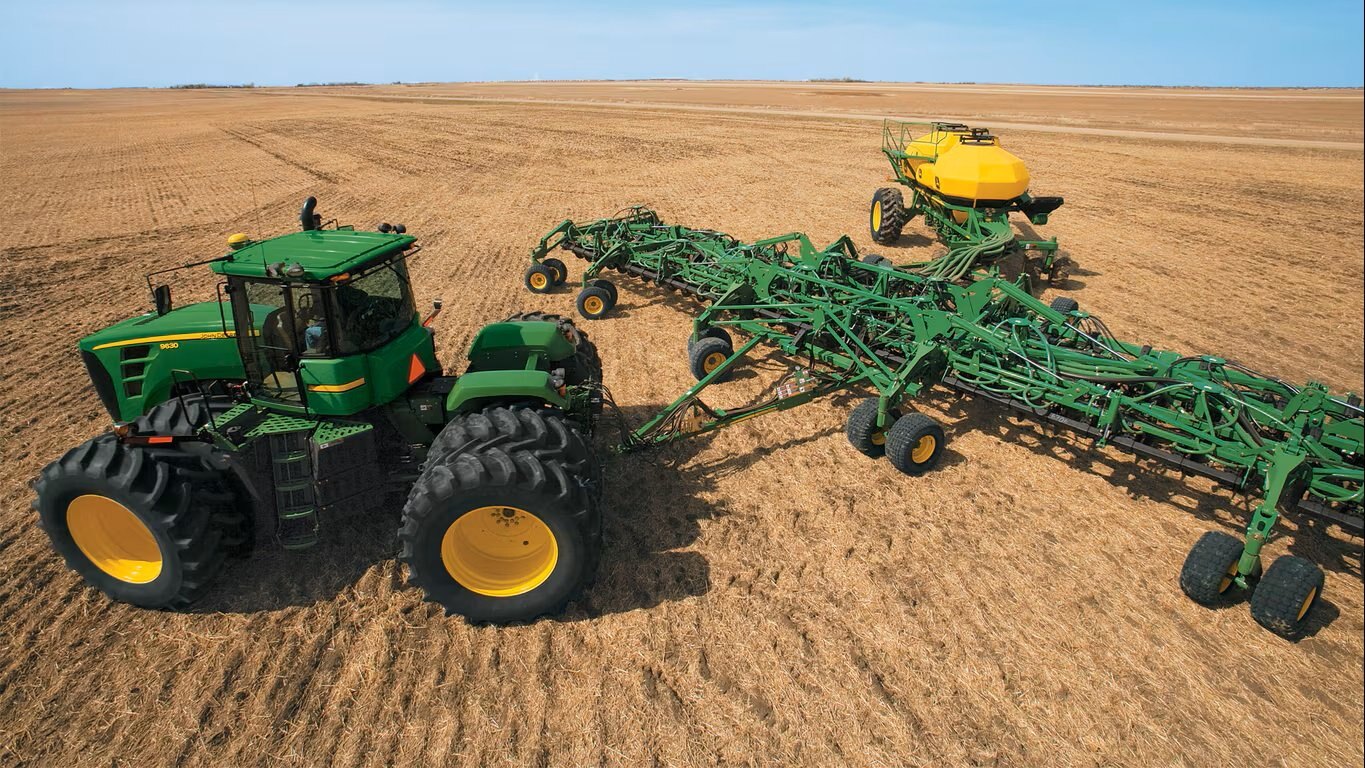
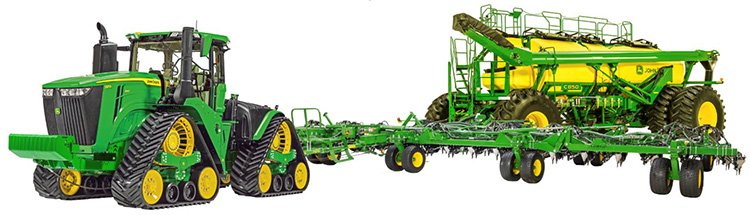
John Deere has the seeding solutions that go above expectations with a complete line of everything needed in small grains. Offering a variety of openers for your chosen practice in a variety of configurations and sizes. All with integrated technology throughout the seeding train allows for effortless setup and seamless documentation.
Setting up a John Deere seeding train is quick and easy with the plug and play technology. All data and technology operate through the Gen 4 display and ultimately up to John Deere Operation Center™ that can be viewed from anywhere at any time. Not only does the complete John Deere seeding solution all operate through one display but it eliminates the difficulty and time-consuming tasks of setting up extra displays and harnesses.
With a complete John Deere seeding solution, there are multiple different onboard and offboard technologies shown below that improve the overall seeding production step. Many of these technologies are exclusive to John Deere. Each of these technologies bring different customer value that overall lead to the ultimate John Deere seeding solution!
Improve confidence and while reducing maintenance with the new AccuRate™ metering system - Combination of stainless steel and composite materials ensure an entire corrosion resistant system
- Individual electric meters allowing for more precise seeding
- Up to 8x more accurate prescriptions with high fidelity prescription
- Start and stop each meter with SectionCommand™ Pro
- Accurately meter the correct amount of product on a curve with curve compensation
Calibrate faster and easier than ever before with EZCal™
ActiveCal™ display Calibrate more frequently from the seat of the cab with ActiveCal™
Save input cost with SectionCommand™Pro
On the go, quick adjust downforce with TruSet™ from the cab
Monitor blockage row by row from the cab with RelativeFlow™
AutoTrac™ Implement Guidance and AutoTrac Turn Automation
John Deere Operation Center™
Operation Center Mobile -
View your data on the go; remotely monitor job quality, productivity, machine performance, and quickly make informed decisions - Manage and monitor from anywhere at any time with near real-time field and machine updates
Connected Support |
|
 Flexible frame allows for consistent seed depth Flexible frame allows for consistent seed depth
Seed depth uniformity
Producers are more attuned to the importance of seed depth than ever before. A uniform-looking field is not the only goal; yield is too. Proven yield penalties across the world range from 5 percent to 25 percent, depending on depth variance.
The H500 and H500F feature diagonal mainframes and wing flexing – helping openers maintain their depth over uneven terrain.
The life requirement of these robust machines is four times longer than previous models. That is why the John Deere seeding group has built even more durability into the H500 and H500F Air Hoe Drills.
An advanced and rigorous testing program has proven the machine durability to the extent that John Deere now offers a three-year frame warranty with each H500 and H500F that rolls out of the factory.
Robust ball joints connect strong fore-aft tubes to 100-mm x 100-mm (4-in. x 4-in.) rank tubes, which are joined to one another by pivoting rank connectors. Both the mainframe and wing sections share this durable construction that enables the frame to flex diagonally, relieving stress on solid frame members and avoiding frame failures.
Seed smart with confidence that the H500 and H500F will endure the field conditions. |
|
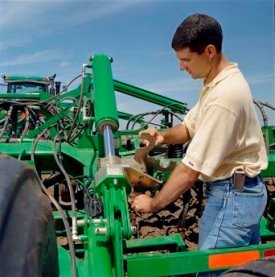 Control the depth of seeding with TouchSet™ Control the depth of seeding with TouchSet™
Setting depth is one of the most critical adjustments an operator will make to a seeding tool. John Deere understands every operator needs dependable, repeatable depth control that is easily adjustable. That is why John Deere provides a choice of two depth control options on the H500 and H500F.
Mechanical depth shims are repeatable and reliable
Often-heard are comments from producers who say they prefer the positive mechanical depth control offered by the 1820. This popular concept is base equipment on the H500 and H550 air hoe drills.
Two indexed depth shim packs on the mainframe are not only easy to set, but reduce the number of adjustment sites over previous designs by up to 60 percent.
Less time adjusting means more time seeding.
TouchSet™ depth control
Changing field conditions such as moisture levels and soil types can make setting depth a challenge. TouchSet depth control makes adjusting depth in response to changing field conditions easy and profitable. On 8R and 9R Series tractors, the operator uses selective control valve (SCV) #1 and the SCV TouchSet control panel to perform all the depth control functions from the seat. Considering yield penalties of 5 percent due to seeding 2.5 cm (1 in.) too deep or too shallow, the convenience of in-cab adjustment pays nicely
How does it work? The operator uses the TouchSet (SCV setup panel) to set or change the operator depth. -
With the implement nine-pin connector connected to the tractor, start the tractor; a P will appear in the window of the control panel under SCV #1. -
The remote sensor located on the rockshaft monitors position of the implement. -
After operating depth is measured at the ground engaging tool and the desired depth obtained, press the lower set button on the control panel. That depth is now set. -
On-the-go depth changes can be made by touching the set button to select a new depth. -
Implement raise height selection uses the upper set button on the control panel to preset the distance the implement is raised above the operating depth.
Preset the raise height to: -
Take out wheel tracks on headlands -
Limit raise height for waterway crossings -
Manual depth override capacity
A remote position sensor (1) is located at the rear of the drill; electronically monitors the positions of the implement.
An electrical connector is used for easy hookup of TouchSet depth control sensor on the implement to the tractor system (8R Tractor illustrated).
NOTES:
-
For use with all 8R and 9R (or older models) Series John Deere tractors. -
TouchSet depth control requires additional tractor parts for hookup; see appropriate tractor section in the Sales Manual.
|
|
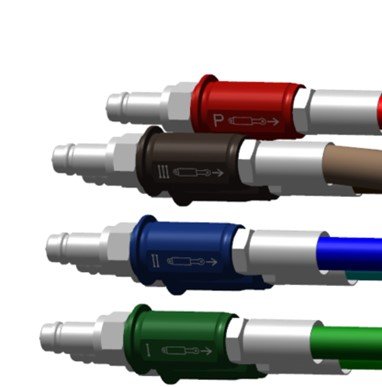
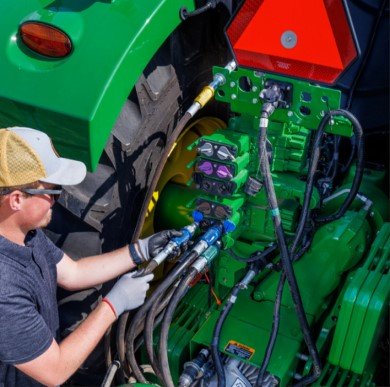 Color-coded hydraulic hose handles Color-coded hydraulic hose handles
These color-coded aluminum hydraulic hose handles make connecting hydraulic hoses from the air seeder and air cart to the correct Selective Control Valve (SCV) on the tractor easier than before. The anti-slip makes it easy to grip the hose and connect or disconnect from the back of the tractor. Each color is laser engraved with the John Deere logo and extend/retract icons to ensure proper matching to the proper function. - Easily identify function of each hose
- Consistently match hose handles colors to rear couplers on tractor
- Easy to grip for connecting or disconnecting to the SCV
- Base equipment on all trailing air carts
- Base equipment on all seeding tools
|
|
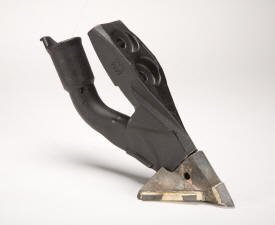
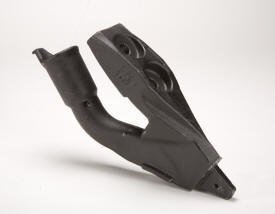 Ground-engaging openers provide benefits of low-disturbance seeding Ground-engaging openers provide benefits of low-disturbance seeding
Knife bodies and points
Many producers enjoy the moisture-saving benefits of low-disturbance seeding. To make it easier for them to reap the rewards of low-disturbance seeding, factory-installed knife bodies are available for H500 and H500F Drills.
The knife bodies are available in 2.5 cm (1 in.) or 10.2 cm (4 in.) spread points.
Use the 2.5-cm (1-in.) point for low disturbance or, if a wider spread pattern is desired to increase seedbed utilization, use the 10.2-cm (4-in.) point. The points can be quickly changed with a single roll-pin fastening system and feature carbide tips to ensure long life.
The knife bodies also feature a positive hose retention system with provisions for a hose clamp to hold the hose in place.
These knife bodies may not perform as designed in wet, sticky soil conditions.
NOTE: Points and roll pins are not included. Points and roll pins are available through Service Parts.
Perma-Loc™ spoons and sweeps
Perma-Loc spoons and sweeps from John Deere offer reduced maintenance because the Perma-Loc design enables a change-out up to five times faster than traditional bolt-on components.
They also offer cost savings because with Perma-Loc spoons and sweeps, there is no more purchasing hardware each time spoons are changed out. This can save $309 USD list price when changing out the spoons on a 18.3-m (60-ft) tool with 19-cm (7.5-in.) spacing.
Shown is the 10.2-cm (4-in.) Perma-Loc spoon; 7.6-cm (3-in.) spoons are also available.
Spoons are not included in base price and must be ordered separately.
Below is the seedbed profile that can be expected if using a 10.2-cm (4-in.) spoon in conventional tillage with the H500F Separate Fertilizer Placement (SFP).
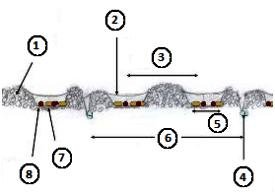
- Tilled soil
- Disturbed soil packed over seed row
- 25.4 cm (10 in.)
- Separate fertilizer placement nitrogen
- 10.2 cm (4 in.)
- 50.8 cm (20 in.)
- Seed
- Seed-placed phosphorus
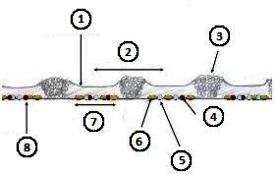
- Disturbed soil packed over seed row with 14-cm (5.5-in.) semi-pneumatic packer
- 25.4 cm (10 in.)
- Tilled soil
- Seed-placed phosphorus
- Seed-placed nitrogen
- Seed
- 17.8 cm (7 in.)
- Seed floor created by sweep
|
|
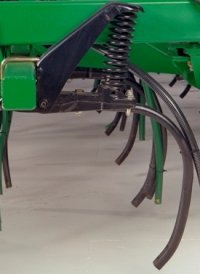 TruPosition™ standards are consistent seed depth and row spacing TruPosition™ standards are consistent seed depth and row spacing
Unmoved
That is how John Deere's TruPosition standard may be described. When the seed depth consistency and row spacing integrity are top concerns, this low-maintenance design will not compromise.
This can translate to a more than 5 percent yield increase by maintaining seed depth in tough ground conditions. The no-bolt design means avoiding maintenance costs and damaging downtime down the road.
It has a 51-degree shank.
Harrow
Seed depth consistency is a function of initial seed placement below the soil surface and displacement of soil over the seed row. When soil throw from the openers is great enough to cover up neighboring seed rows, a harrow is recommended to level the seedbed and equalize displaced soil over all seed rows prior to packing.
quipping an H500 with the optional two-bar harrow helps level the seedbed before packing, ensuring an even distribution of soil over all seed rows. Adjustments include both vertical and tine-pitch, allowing the operator to set the harrow for the level of aggressiveness needed to level the seedbed.
NOTE: Not recommended for seeding into surface residue levels exceeding 35 percent.
NOTE: Harrow is not compatible with H500F.
- Disturbed soil packed over seed row with 14-cm (5.5-in.) semi-pneumatic packer.
- 25.4 cm (10 in.)
- Tilled soil
- Seed-placed phosphorus
- Seed-placed nitrogen
- Seed
- 17.8 cm (7 in.)
- Seed floor created by sweep
The seeding profile behind an H500 equipped with a harrow and sweeps will look similar to the image on the left. A flat seed floor with seed distributed over 50 percent of the row spacing for 25.4-cm (10-in.) configurations using the Perma-Loc™ boot and sweep. |
|
 Be at ease with Separate Fertilizer Placement (SFP) Be at ease with Separate Fertilizer Placement (SFP)
Fertilizer inputs can represent 30 percent to 35 percent of the cost in small grain and oil seed production. It is no wonder farmers are concerned about nitrogen losses from gas escape, volatilization and leaching.
One opener combines four key processes to minimize nutrient losses through precise nutrient placement at seeding. John Deere’s SFP disc opener features: - Active hydraulic downforce
- Depth gauging at the opener
- Ultra-low soil and residue disturbance
- Positive closing system
All of these lock in dry, liquid, or gas forms of nitrogen.
There is no more worrying about pre-season nitrogen loss due to denitrification and leaching. Operators can forget about volatilization of top-dress applications, and maybe most notably, endure a day of seeding without the burning nasal passages that accompany poor anhydrous ammonia retention.
Key features of the opener include: - Depth gauging at the opener with 11.4-cm (4.5-in.) or 7.6-cm (3-in.) semi-pneumatic gauge wheels
- Depth adjustments are in 6 mm (1/4 in.) increments from 1.3-cm (1/2-in.) to 9-cm (3-1/2-in.) deep
- 5-degree operating angle creates a narrow trench and minimizes soil disturbance
- Close-coupled closing wheel assembly for quick trench closure and maximum fertilizer retention
-
NOTE: Closing wheels are base equipment on anhydrous openers and optional on liquid and dry openers. Closing wheels are recommended.
- Extended-wear (chrome alloy) fertilizer boots
- Sealed, non-greaseable bearings
Fertilizer tubes
There are four choices of interchangeable fertilizer tubes:
- Dry fertilizer tube to be used with 32-mm (1-1/4-in.) secondary fertilizer hose from the 1910 Commodity Cart
- Liquid fertilizer tube (for 13-mm [1/2-in.] ID hose) – using this tube for anhydrous may cause loss of retention*
- Dual fertilizer delivery tube – allows for placement of dry or anhydrous. If applying both simultaneously, the operator may need to provide a relief system to relieve air from dry tube for adequate anhydrous retention. Without air relief, the operator will need to adjust air plenum to restrict all airflow to SFP dry tubes when anhydrous is being applied.*
- Anhydrous tube (for 10-mm [3/8-in.] ID hose)*
* NOTE: Liquid or NH3 Fertilizer metering/delivery system is not provided by the John Deere seeding group.
Opener gauge wheel
11.4-cm x 40.6-cm (4.5-in. x 16-in.) semi-pneumatic wheel gauges depth - Standard smooth plastic hub for minimal soil disturbance in mellow soils
- Depth can be controlled from 0.6 x 9 cm (1/4 to 3-1/2 in.) in 6-mm (1/4-in.) increments (13 total adjustments)
- Runs on sealed, double row tapered ball bearings
7.6-cm x 40.6-cm (3-in. x 16-in.) gauge wheel (optional) - Less stubble or residue disturbance
- Depth can be controlled from 0.6 to 9 cm (1/4 to 3-1/2 in.) in 6-mm (1/4-in.) increments (13 total adjustments)
Opener furrow closing wheel
2.5-cm x 30.5-cm (1-in. x 12-in.) cast closing wheel follows the press wheel to close furrow, placing soil over seed or fertilizer after the press wheel secures seed in furrow. - A double-row ball bearing to reduce wear is located in the arm of the closing wheel
- Mounted parallel to the furrow opener, the closing wheel can be adjusted laterally to allow running on top of furrow for sandy or mellow soils or to side of furrow for heavier soils
- Down pressure is adjustable from 12 kg to 19.5 kg (26 lb to 43 lb) (no tools and three adjustments).
|
|
 Fertilizer options with separate fertilizer placement (SFP) Fertilizer options with separate fertilizer placement (SFP)
Separate fertilizer placement offers nutrient placement at a 5 or 7-degree angle
The 5-degree fertilizer opener: - Is required for liquid and anhydrous (NH3) fertilizers
- Will also apply dry fertilizer
- Opens a smaller trench than the 7-degree opener
- Is better able to capture anhydrous and liquid fertilizer and seal fertilizers in the soil
Fertilizer tubes
There are four choices of interchangeable fertilizer tubes: - Dry fertilizer tube to be used with 32-mm (1-1/4-in.) secondary fertilizer hose from the 1910 Cart
- Liquid fertilizer tube (for 13-mm [1/2-in.] i.d. hose)
-
IMPORTANT: Using this tube for anhydrous may cause loss of retention.
- Dual fertilizer delivery tube – allows for placement of dry or anhydrous. If applying both simultaneously, the operator may need to provide a relief system to relieve air from dry tube for adequate anhydrous retention. Without air relief, the operator will need to adjust air plenum to restrict all airflow to SFP dry tubes when anhydrous is being applied
- Anhydrous tube (for 10-mm [3/8-in.] i.d. hose)
- Liquid or NH3 fertilizer metering/delivery system is not provided by the John Deere Seeding Group.
Key features of the SFP opener are: - 457.2-mm (18-in.) opener blades operate at 5 degrees, resulting in a narrow trench with less soil disturbance
- Fertilizer tubes are interchangeable among dry, liquid, or anhydrous (NH3)
- Closing wheel assembly is closer to the fertilizer delivery tube; provides increased fertilizer retention
- Serrated closing wheels are base equipment on anhydrous openers and optional on liquid and dry openers
-
NOTE: Closing wheels are recommended when dry soil conditions are common.
- Extended-wear (chrome alloy) fertilizer boots are standard equipment
- Choice of five different gauge wheels
- Depth adjustments in 6-mm (1/4-in.) increments from 13 mm to 89 mm (1/2 in. to 3.5 in.) deep
Opener furrow-closing wheel
The 25-mm x 305-mm (1-in. x 12-in.) cast closing wheel follows the press wheel to close the furrow, placing soil over seed or fertilizer after the press wheel secures the seed in the furrow. - A double-row ball bearing to reduce wear is located in the arm of the closing wheel
- Mounted parallel to the furrow opener, the closing wheel can be adjusted laterally to allow running on top of the furrow for sandy or mellow soils or to side of the furrow for heavier soils
- Down pressure is adjustable from 11.8 kg to 19.5 kg (26 lb to 43 lb) (no tools and three adjustments)
- A grease fitting in the pivot arm provides free movement for the arm
SFP upgrade kit
SFP scrapers can bolt a sealing wing to the bottom of the improved anhydrous (NH3) retention by reducing outgassing. It is made of steel and has carbide titles brazed to the edges for long life. - Parts: AA102150 and AA102151
The SFP opener closing arm spring will better hold the notched retention position. When selecting options for anhydrous fertilizer delivery, the SFP opener has a carbide sealing wing. The sealing wing agitates the trench sidewall and helps seal the top of the furrow with soil. This helps facilitate the binding of anhydrous ammonia to the soil, which reduces outgassing, keeps more fertilizer in the ground, and provides a boost to young plants. |
|
 Stabilize nitrogen retention with separate fertilizer placement (SFP) Stabilize nitrogen retention with separate fertilizer placement (SFP)
Fertilizer inputs can represent 30 percent to 35 percent of the cost in small-grain and oil seed production. It is no wonder producers are concerned about nitrogen losses from gas escape, volatilization, and leaching.
Nitrogen loss pathways
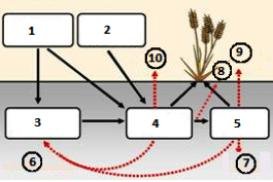
- Manure and crop residues
- 46-0-0
82-0-0
28-0-0 (75 percent) - Soil organic N
- Ammonium NH4+
- Nitrate NO3+
- Immobilization
- Leaching and runoff
- NO
N2O - N2+
N20 Denitrification - NH3 Volatilization
Nitrogen (N) loss occurs via four key pathways.
- Volatilization of anhydrous ammonia (NH3) into the atmosphere.
- Immobilization, or the uptake of nitrogen by microbes breaking down residue.
- Leaching or runoff of N2 or NO2 (nitrite).
- Volatilization of N2 or NO2 (nitrite).
Denitrification is the conversion of nitrate (NO3) to nitrite (NO2), and eventually to N2 or N2O (nitrous oxide). These nitrogen forms are not held by the soil complex like NO3 and NH4 and are subject to escape via water.
The SFP opener features: - Single-disk blade slices through the soil at a five-degree angle
- Opener is adjusted via active hydraulic-down pressure
- Depth gauging is accomplished at the opener
- Closing wheel ensures fertilizer stays where it is applied
Ultra-low soil, moisture, and residue disturbance, plus the cast closing wheel, are able to lock in dry, liquid or gaseous fertilizer.
IMPORTANT: Furrow closing wheels are required when applying anhydrous fertilizer.
Plus, application at seeding means no more worrying about pre-season nitrogen loss due to de-nitrification and leaching. Reduce dependence on risky top-dress applications where volatilization and immobilization can significantly reduce crop uptake. Fertilizer can now be applied in the seeding operation with confidence, knowing it is firmly in place where it belongs in the soil. |
|
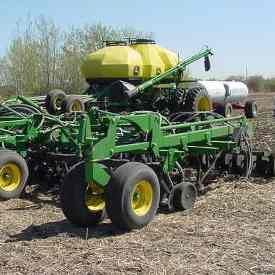 Apply fertilizer at a safe distance with Separate Fertilizer Placement (SFP) Apply fertilizer at a safe distance with Separate Fertilizer Placement (SFP)
Researchers observed stand reductions up to 5 percent in wheat and 26 percent in canola (PAMI 738) when nitrogen fertilizer was placed near the seed. Those are the risks and possible consequences for nitrogen application too close to the seed.
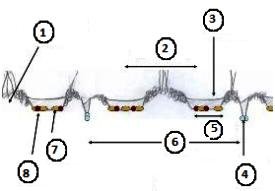
- Undisturbed soil
- 25.4 cm (10 in.)
- Disturbed soil packed over seed row
- SFP nitrogen
- 10.2 cm (4 in.)
- 50.8 cm (20 in.)
- Seed
- Seep-placed phosphorus
John Deere seeding group thinks sound nitrogen management should be rewarded. That is why the H500F SFP Air Hoe Drill was designed with the exclusive SFP opener to place nitrogen, potassium and sulfur-based fertilizers separate from the seed. This positive separation of fertilizer and seed eliminates seedling damage caused by some fertilizer forms and application methods.
Understanding distance between seed and fertilizer placement
When seeding with the H500F SFP, the seed opener will have an effect on the distance between the seed and fertilizer. For example, as the diagram above shows, seeding with a 10.2-cm (4-in.) spread places the seed between 20.3 cm (8 in.) and 30.5 cm (12 in.) from the fertilizer in the same furrow.
NOTE: Narrow spread openers are recommended to keep a consistent distance between seed and fertilizer.
IMPORTANT: The H500F SFP is also capable of applying safe rates of starter fertilizer with the seed. |
|
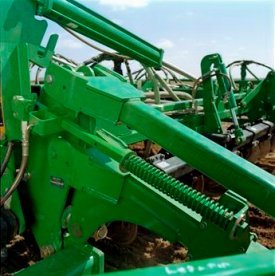 Reduce transport height Reduce transport height
Transporting large machines on public roads can be a little stressful. Passing motorists, mailboxes, overhead lines, and trees can all contribute to potential hazards.
With so much to focus on, the H500 Air Hoe Drill operator should not have to worry about openers engaging the pavement when lowering a machine to clear an overhead obstacle.
With the optional transport height reduction feature, the operator does not need to worry. This handy feature can also serve to set the height for storage inside.
Simply setting the pin in the appropriate hole will stop the machine from lowering when the openers are a safe distance above the pavement.
The operator can focus on the overhead obstacle and other hazards such as passing motorists near the machine. This can prevent a potentially damaging encounter with the road surface or even an accident. |
|
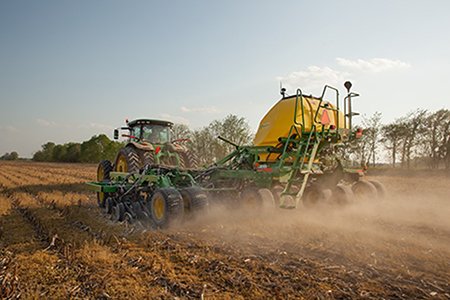 John Deere Seeding cover crop solutions John Deere Seeding cover crop solutions
Why cover crops?
With proper management and the right selection of cover crops, you can slow soil erosion, improve soil health, enhance water availability, suppress weeds, control pests and diseases, increase biodiversity, and reap numerous other benefits for your farm’s health and profitability. Cover crops act as a protective shield for the soil, reducing the impact of heavy rains and wind, which in turn minimizes topsoil loss. They improve soil structure by adding organic matter and fostering beneficial soil microorganisms, which enhances nutrient cycling and retention.
Additionally, cover crops can break up compacted soil layers, improving root penetration and water infiltration. By suppressing weeds, they reduce the need for chemical herbicides, leading to more sustainable farming practices. Cover crops also provide beneficial habitat for insects and pollinators, boosting on-farm biodiversity. Furthermore, they can help in sequestering carbon, contributing to climate change mitigation. Overall, integrating cover crops into your farming system can lead to more resilient and productive agricultural landscapes, ultimately enhancing long-term profitability.
What tool works best for you?
The N500C model machines provide extensive crop compatibility, making them an excellent choice for customers looking to seed multiple crops and crop blends using a single tool. These machines can be customized with two unique rollers in multiple sizes to meet the specific needs of each operation. Refer to the crop compatibility link by roller below. Additionally, the N500C is capable of seeding in various soil conditions and residue types. Featuring the Pro-Series No-Till opener, it is designed to handle a wide range of conditions, from heavy residue to lightly worked soils. For more information, see the Sales Manual links below.
Box Drills are an excellent choice for seeding cover crops, offering simplicity and high placement accuracy. Equipped with the Pro-Series No-Till opener, the 1590 Box Drill can handle a variety of conditions, from heavy residue to lightly worked soils. The 455 and BD11 Series Box Drills, featuring a double disk opener, are ideal for tilled seed beds. They also provide wider widths and a range of spacing options. For more information, see the Sales Manual link below.
Already have an Air Seeder?
Any John Deere air cart compatible tools are excellent options for seeding cover crops. Air carts come with multiple tanks, enabling you to combine or blend your cover crop mixes effectively. With a wide range of meter roller options, air carts can be easily tailored to meet your specific cover crop needs and paired with the most suitable tool for the job. For more information, see the Sales Manual links below. |